
Social Security
Social Security Claiming Ages Explained
By Natalie Contorno Lee··5 min read
By Natalie Contorno Lee, Licensed Insurance Broker and Registered Social Security Analyst — Houston, TX
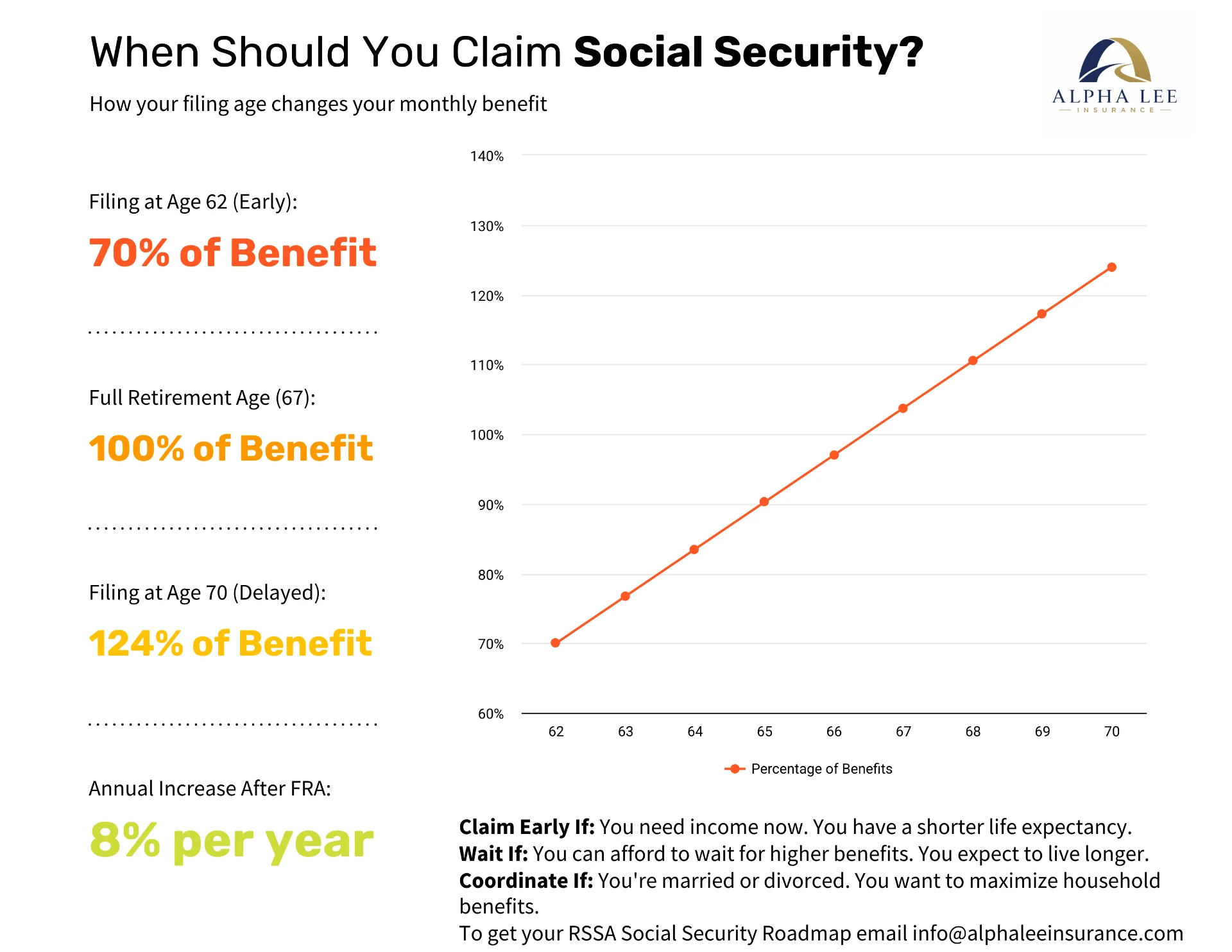
Deciding when to claim Social Security is one of the largest financial decisions most people make, and it is usually made with the least information. The chart above condenses the core math: your filing age permanently changes the size of every monthly check you will ever receive.
What the numbers mean
Your full retirement age (67 for most people born in 1960 or later) is the point at which you receive 100% of your primary insurance amount. Filing earlier reduces that amount permanently. Delaying past full retirement age earns delayed retirement credits of roughly 8% per year until age 70.
If your FRA is 67—which applies to people born in 1960 or later—claiming Social Security retirement benefits at 62 provides 70% of your full retirement benefit.
- Age 62 — about 70% of your full benefit. The earliest you can file, and the reduction does not go away later.
- Age 65 — about 86%. Often chosen because it is when Medicare begins, though the two decisions are separate.
- Age 67 — 100%. Full retirement age for most people retiring today.
- Age 70 — about 124%. The maximum. There is no benefit to waiting past 70.
The decision is rarely just about the math
A break-even calculation is a useful starting point, but it isn't the whole answer. In practice, the filing age that works best depends on:
- Household income needs. If you need the income now, claiming early can be the right call.
- Health and longevity. Family history and current health matter more than averages.
- Marital status. A higher earner delaying can raise the survivor benefit for a spouse for life.
- Taxes. Up to 85% of benefits can be taxable depending on combined income, so filing timing interacts with IRA withdrawals and Roth conversions.
- Whether you are still working. Before full retirement age, the earnings test can temporarily withhold benefits.
How to use this infographic
You are welcome to share this infographic in employee benefits newsletters, HR presentations, retirement workshops, or your own blog. The only requirement is attribution with a link back to this page. HR teams and employers frequently use it as the opening slide of a pre-retirement education session.
Get your own numbers
The chart shows percentages. Your decision depends on dollars — your actual earnings record, your spouse's record, and how the two interact. As a Registered Social Security Analyst practice, we can model your filing combinations side by side and show the projected lifetime difference. There is no cost and no obligation.
Ready to protect your future?
Explore long-term care options designed around your goals, budget, and family.
Not sure which claiming age is right for you?
Get a Registered Social Security Analyst® review of your options — or book a call and walk through it together.
Frequently Asked Questions
- Can I use this Social Security infographic on my own site?
- Yes. The infographic is free to share for personal, educational, HR, or editorial use. We ask only that you include attribution to Alpha Lee Insurance with a link back to this page.
- What percentage of my benefit do I get if I claim at 62?
- If your full retirement age is 67, filing at 62 gives you about 70% of your full benefit, and that reduction is permanent. The exact percentage varies slightly depending on your birth year.
- Is it always better to wait until 70?
- No. Waiting produces the largest monthly check, but it is not automatically the best choice. Health, immediate income needs, spousal and survivor benefits, taxes, and whether you are still working can all point toward filing earlier.
- Does claiming Social Security affect my Medicare enrollment?
- They are separate decisions. Medicare eligibility begins at 65 regardless of when you claim Social Security, though if you are already receiving benefits you are typically enrolled in Parts A and B automatically.
Free Social Security Analysis
Get your free Social Security claiming analysis
Tell us a little about your situation and we'll send back a Registered Social Security Analyst® review of your claiming options — no cost, no obligation.
Want a personalized plan?
Book a no-pressure conversation with Natalie to walk through your options.
Schedule a Call